
Sagging Flex Duct: How It Affects HVAC Airflow
Flexible duct can move air effectively when it is installed correctly. Sagging, compression, and sharp bends can add resistance and reduce the airflow reaching a room.
Flex duct works best when the inner liner is pulled tight and the duct is properly supported. Excess slack, sagging, compression, and sharp bends can increase static pressure and reduce airflow.
Why Flex Duct Installation Matters
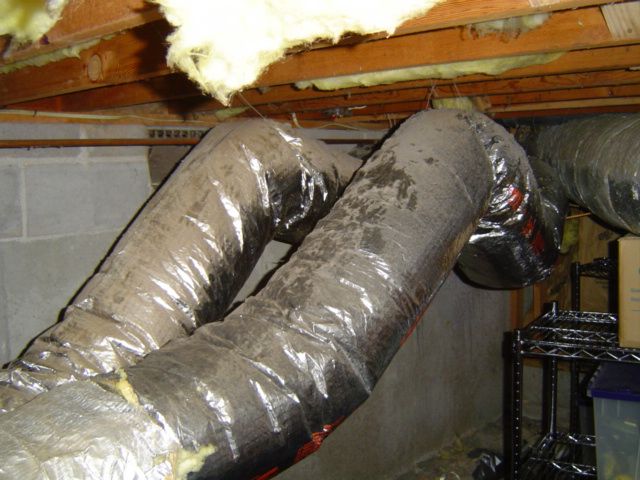
Flexible duct has a ribbed inner liner. When the duct is stretched close to its full length, that liner stays relatively smooth and air can move through it more easily.
When excess duct is compressed into a shorter space, the inner liner becomes more wrinkled. Those folds create additional resistance. Sagging between supports can make the problem worse.
That means two ducts with the same diameter can perform very differently depending on how they are installed.
- Weak airflow from supply registers
- Rooms that heat or cool unevenly
- Longer HVAC run times
- Increased fan workload
- Higher airflow resistance
- Difficulty balancing the system
What Research Found
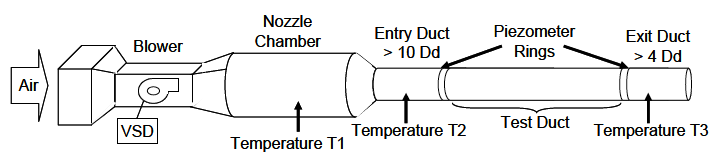
Researchers Kevin Weaver and Dr. Charles Culp evaluated airflow and static-pressure losses in 6-inch, 8-inch, and 10-inch non-metallic flexible duct.
They compared fully extended flex duct with increasing levels of compression and different support conditions, then compared those results with rigid metal duct.
Performance declined as flex duct was increasingly compressed or allowed to sag.
Even a Small Amount of Compression Can Matter
One of the most useful examples from the research involved 6-inch duct at approximately 0.1 inches of water column static pressure.
| Duct Condition | Approximate Airflow |
|---|---|
| Rigid metal duct | About 110 CFM |
| Flex duct with 4% compression | About 70 CFM |
That is a substantial difference from a relatively small amount of compression.
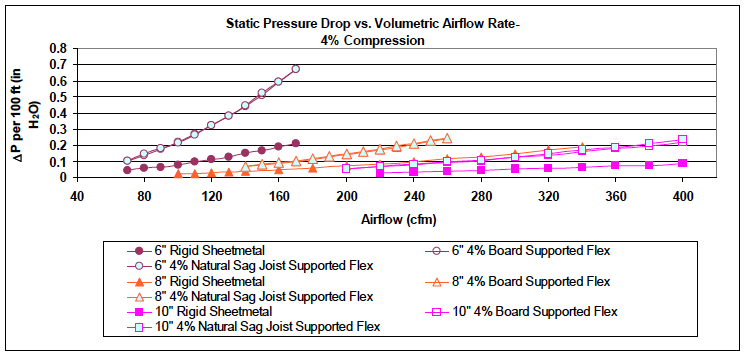
At 15%, 30%, and 45% compression, progressively more pressure was required to maintain the same airflow.
What Sagging Does
Compression and sag are related, but they are not identical.
In the testing, some flex duct was fully supported while other sections were supported across joists. The joist-supported sections developed sag between supports.
At higher compression levels, sagging duct generally created greater resistance than better-supported flex duct.
Sharp Bends Can Make Airflow Worse
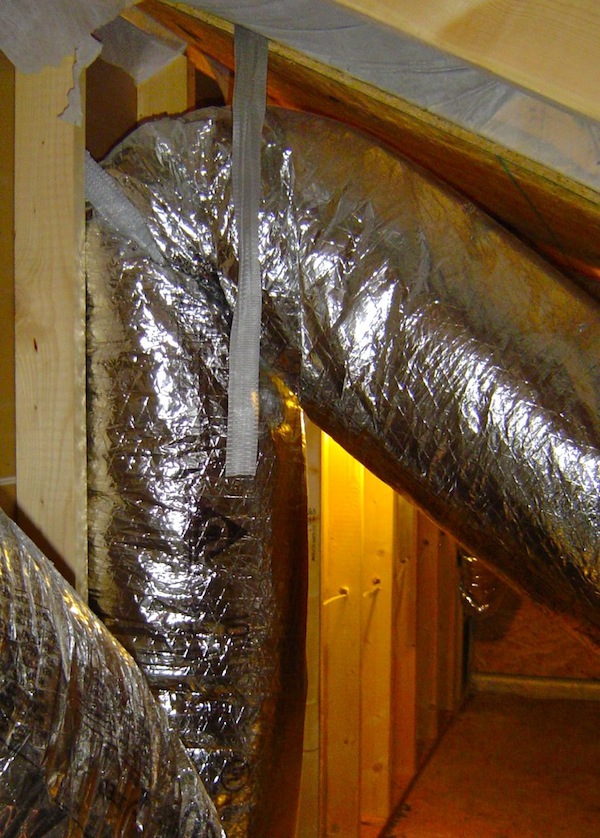
The research above focused on straight runs of flexible duct. Real homes can introduce another source of resistance: sharp turns and kinks.
A tightly bent section changes the shape of the duct and can add turbulence to the airflow. That means an airflow problem can exist even when the duct itself is not dirty.
What Homeowners Can Look For
Visible flex duct can sometimes reveal obvious installation concerns.
- Long sections hanging deeply between supports
- Excess duct bunched into a short run
- Sharp bends or kinks
- Duct that appears flattened or crushed
- Weak airflow from the register served by that duct
- A room that stays hotter or colder than nearby rooms
Dirty filters, coil buildup, return-air restrictions, duct leakage, closed dampers, system balancing, and equipment issues can create similar symptoms.
Flex Duct Is Not Automatically a Problem
Flexible duct itself is not the issue.
When appropriately sized, properly stretched, supported, and routed, flex duct can be a practical part of an HVAC system.
The problem is installation that adds unnecessary resistance to airflow.
Static Pressure Losses in Non-Metallic Flexible Ducts
The airflow findings summarized on this page are based on research by Kevin Weaver and Dr. Charles Culp examining static-pressure losses in 6-inch, 8-inch, and 10-inch non-metallic flexible duct. The study was later discussed in building-science analysis by Allison Bailes.
Dealing With Weak or Uneven Airflow?
Safety King provides duct system inspection and air duct cleaning services for homes in Michigan.